Summary: It's third quarter time. How have you met your goals for the year? Check out today's post on two POW Phrases of the Week, mind maps and vision boards, to learn not just new terms, but new tools to help you succeed.
It's POW Phrase of the Week time again. And the two POWs I'd like to share are also excellent tools: mind maps and vision boards. I've been tweeting a lot lately about vision boards (not to mention doling them out as assignments to my coaching clients). I've even started a new vision board for some of my own personal goals.
Not familiar with a vision board? Check out this article with a great explanation, DIY how-tos, sample images, plus some great inspirational quotes by my fave guru Tony Robbins.
As the article explains, vision boards are great ways to creatively envision your goals and bring them top of mind. The more attention you give your goals, the more likely you are to focus on them—consciously or sub-consciously—and bring them into your life. And when it comes to goal-setting, you can't get more pragmatic than use of a mind map.
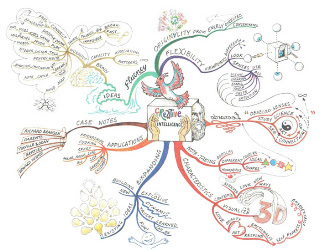
So, what's a mind map? Click here to read a basic overview that also lists some of the many uses, then check out my favorite template to share with clients below.
For non-linear thinkers and planners, especially those with ADHD or any ADD-like thinking, mind maps are excellent ways to capture ideas as they occur and (most importantly) act on them. You can write a speech, article or other presentation using a mind map, too. From the linked article above, here's a beautiful and creatively hand-drawn version:
© KiKi Productions, Inc. 2012
Showing posts with label ADD. Show all posts
Sep 10, 2012
Nov 19, 2010
Coaching My Dad
Summary: My favorite client is the one I'm working with right NOW—whenever now may be. Despite that, here's one story that will live in my heart forever (and that I simply have to share with you). This is how I coached my dad ....
I'm a lucky woman: I've got a wonderful father who's always been a very involved part of my life from childhood through my present adult years. He has been a role model not only to me, my sisters and other members of our family, but he's also someone that people in our small community (the town in Indiana where I grew up) have looked up to all my life. As a grown-up now, I can see why.
Dad is consistent in
his beliefs and in his actions. He's very friendly and tries his best to welcome others. And he just plain likes to have fun. Diplomatic, protective, open-minded and open-hearted: These are a few other words that come to mind to describe him.
Imagine how honored I was to be able to give something back to someone like this. It's an experience I had relatively recently, and one I know I'll always remember and cherish.
At age 60, Dad is a new student. He's gone back to school—again—this time, studying for his Masters in Divinity. He was very excited about it at the outset. (We all were!) But when I went home to visit a few weeks ago, his enthusiasm had decidedly waned.
"How are you?" I greeted him in his office.
He made a noise that was part groan and part growl. "Not good," he answered honestly. "I've got a paper due in Theology, and I have no idea what I'm doing."
Little did he know, Mom had already prepped me, saying, "Your dad's really struggling with his classes this semester. It's the reading that's doing him in. You love to read. Do you think you could give him some pointers when you're home?" I wasn't sure if I'd be of any use in this area. If not for Mom's nudging, I may well have simply sympathized with my dad, then left him alone in his office to tackle his studies on his own (flailing) terms. But instead, I offered to listen.
I listened as he detailed how lost he'd felt in his classes, wondering what academia had to do with spirituality. I listened as he described how his ADD seemed to be more distressing than ever when he sat down to read. And I heard the sadness and saw the despair in his voice, words and body language.
That's when the coach in me kicked in. Over the next two days, we spent the bulk of our time in the office: Mom popped in from time to time to give one or both of us a hug or offer us some hot tea; Dad and I surrounded ourselves with his textbooks, a dictionary of theological terms and his past essay papers. We huddled together over the computer, sometimes with a cat on one of our laps, or leaned back in our chairs to make sweeping gestures as we shared expansive thoughts. When it was all said and done, Dad had a number of action items on his calendar (meet with his study group or study solo at the library on class days, for example), several tools in his study arsenal (like a dictionary on his smart phone and a running list of new vocabulary words), and a mantra—or customized affirmation—that gave him complete peace of mind over his process ("I do have the time, and I do know the words").
Most gratifying to me was this: Not only did my dad say he understood the material now more than he had in six weeks, he had his head held up high, his shoulders squarely back, and a smile on his face again. Dad had rediscovered his self-confidence in his place in seminary.
What do you think lack of time and lack of knowledge are holding back in your life? Do you really have the time? Do you really know the words? Dad does now. He's even been using his new-found knowledge where he'll need it most: the pulpit.
© KiKi Productions, Inc. 2010
I'm a lucky woman: I've got a wonderful father who's always been a very involved part of my life from childhood through my present adult years. He has been a role model not only to me, my sisters and other members of our family, but he's also someone that people in our small community (the town in Indiana where I grew up) have looked up to all my life. As a grown-up now, I can see why.
Dad is consistent in
his beliefs and in his actions. He's very friendly and tries his best to welcome others. And he just plain likes to have fun. Diplomatic, protective, open-minded and open-hearted: These are a few other words that come to mind to describe him.Imagine how honored I was to be able to give something back to someone like this. It's an experience I had relatively recently, and one I know I'll always remember and cherish.
At age 60, Dad is a new student. He's gone back to school—again—this time, studying for his Masters in Divinity. He was very excited about it at the outset. (We all were!) But when I went home to visit a few weeks ago, his enthusiasm had decidedly waned.
"How are you?" I greeted him in his office.
He made a noise that was part groan and part growl. "Not good," he answered honestly. "I've got a paper due in Theology, and I have no idea what I'm doing."
Little did he know, Mom had already prepped me, saying, "Your dad's really struggling with his classes this semester. It's the reading that's doing him in. You love to read. Do you think you could give him some pointers when you're home?" I wasn't sure if I'd be of any use in this area. If not for Mom's nudging, I may well have simply sympathized with my dad, then left him alone in his office to tackle his studies on his own (flailing) terms. But instead, I offered to listen.
I listened as he detailed how lost he'd felt in his classes, wondering what academia had to do with spirituality. I listened as he described how his ADD seemed to be more distressing than ever when he sat down to read. And I heard the sadness and saw the despair in his voice, words and body language.
That's when the coach in me kicked in. Over the next two days, we spent the bulk of our time in the office: Mom popped in from time to time to give one or both of us a hug or offer us some hot tea; Dad and I surrounded ourselves with his textbooks, a dictionary of theological terms and his past essay papers. We huddled together over the computer, sometimes with a cat on one of our laps, or leaned back in our chairs to make sweeping gestures as we shared expansive thoughts. When it was all said and done, Dad had a number of action items on his calendar (meet with his study group or study solo at the library on class days, for example), several tools in his study arsenal (like a dictionary on his smart phone and a running list of new vocabulary words), and a mantra—or customized affirmation—that gave him complete peace of mind over his process ("I do have the time, and I do know the words").
Most gratifying to me was this: Not only did my dad say he understood the material now more than he had in six weeks, he had his head held up high, his shoulders squarely back, and a smile on his face again. Dad had rediscovered his self-confidence in his place in seminary.
What do you think lack of time and lack of knowledge are holding back in your life? Do you really have the time? Do you really know the words? Dad does now. He's even been using his new-found knowledge where he'll need it most: the pulpit.
© KiKi Productions, Inc. 2010
Jul 21, 2010
What Type of ADD Do You Exhibit?
Summary: Did you know that ADD symptoms can suggest a specific type of ADD diagnosis? It's not as complicated as you might think. Take this brief quiz to learn more--about ADHD and you.
Have you ever been diagnosed with or thought you could pass for having ADD? Have you ever thought your spouse, romantic partner, children or even your co-workers might have it? If so, answer these questions--on your own or their behalf--to learn more:
(1) How frequently do you struggle with listening to someone else speak?
A. Often: Whether it's a formal presentation or 10-minute conversation, I'm often thinking of something else the entire time.
B. Sometimes--but mostly because I want to jump up and invite them to an adventure.
(2) Do you often lose your keys, wallet, ID or other important items?
A. Yes, even when I create a 'system' to track them.
B. No, this isn't much of a problem for me ... unless you count intentionally burying them in the snow just for a laugh!
(3) Have you ever regretted an action even as you were doing it--but not been able to stop?
A. No ... unless it was the act of interrupting someone who was speaking.
B. Yes! (Please don't make me say more.)
(4) Do you frequently overspend your budget on items you don't need, even duplicate items?
A. I have done this before, but it's not a common practice.
B. I do this all the time.
(5) Do you tell little white lies (or big ones) without even realizing you're doing it?
A. Only when the story I'm telling is really, really boring and I need to obviously exaggerate to make it more fun.
B. I think I may have a chronic problem with this.
(6) Is reading a chore for you?
A. I have a hard time paying attention to anything I read, watch or hear.
B. It can be--usually because I can't sit still for that long.
There are three basic subtypes of ADHD: The first is known as "Predominantly Inattentive Attention Deficit Disorder." The second, true ADHD, is called "Predominantly Hyperactive-Impulsive." "Combined" is the subset of ADD/ADHD that features symptoms of both inattention and hyperactivity-impulsivity. (A fourth subtype is known as "Not Otherwise Specified," meaning it doesn't fall easily into one of the other categories.) What category are you in? Let's look at your quiz scores:
If you answered "A" 4-6 times, your subcategory is likely inattentive. If you answered "B" 4-6 times, your subcategory is likely hyperactive-impulsive. Of course, if your answers were fifty-fifty, 3 "As" and 3 "Bs," you qualify as having combined ADD/ADHD. But if you had a hard time identifying with any of the answers, your ADD may fall into that fourth subtype--or you may not have it at all.
NOTE: This test is not meant as a substitute for a psychological evaluation or diagnosis. Its scoring system has not been ranked by any psychiatrist or psychological association. If you believe you do have ADHD, please seek professional, accredited help.
© KiKi Productions, Inc. 2010
Have you ever been diagnosed with or thought you could pass for having ADD? Have you ever thought your spouse, romantic partner, children or even your co-workers might have it? If so, answer these questions--on your own or their behalf--to learn more:
(1) How frequently do you struggle with listening to someone else speak?
A. Often: Whether it's a formal presentation or 10-minute conversation, I'm often thinking of something else the entire time.
B. Sometimes--but mostly because I want to jump up and invite them to an adventure.
(2) Do you often lose your keys, wallet, ID or other important items?
A. Yes, even when I create a 'system' to track them.
B. No, this isn't much of a problem for me ... unless you count intentionally burying them in the snow just for a laugh!
(3) Have you ever regretted an action even as you were doing it--but not been able to stop?
A. No ... unless it was the act of interrupting someone who was speaking.
B. Yes! (Please don't make me say more.)
(4) Do you frequently overspend your budget on items you don't need, even duplicate items?
A. I have done this before, but it's not a common practice.
B. I do this all the time.
(5) Do you tell little white lies (or big ones) without even realizing you're doing it?
A. Only when the story I'm telling is really, really boring and I need to obviously exaggerate to make it more fun.
B. I think I may have a chronic problem with this.
(6) Is reading a chore for you?
A. I have a hard time paying attention to anything I read, watch or hear.
B. It can be--usually because I can't sit still for that long.
There are three basic subtypes of ADHD: The first is known as "Predominantly Inattentive Attention Deficit Disorder." The second, true ADHD, is called "Predominantly Hyperactive-Impulsive." "Combined" is the subset of ADD/ADHD that features symptoms of both inattention and hyperactivity-impulsivity. (A fourth subtype is known as "Not Otherwise Specified," meaning it doesn't fall easily into one of the other categories.) What category are you in? Let's look at your quiz scores:
If you answered "A" 4-6 times, your subcategory is likely inattentive. If you answered "B" 4-6 times, your subcategory is likely hyperactive-impulsive. Of course, if your answers were fifty-fifty, 3 "As" and 3 "Bs," you qualify as having combined ADD/ADHD. But if you had a hard time identifying with any of the answers, your ADD may fall into that fourth subtype--or you may not have it at all.
NOTE: This test is not meant as a substitute for a psychological evaluation or diagnosis. Its scoring system has not been ranked by any psychiatrist or psychological association. If you believe you do have ADHD, please seek professional, accredited help.
© KiKi Productions, Inc. 2010
Jul 19, 2010
WORD OF THE WEEK: Introspectional
Summary: This week's vocabulary word, introspectional, correlates to today's new poll and the current subject of ADD brain and social challenges. Read ahead to see for yourself--and then respond to the questions at the end of the post with any life lessons you care to share.
I've posted a new poll especially for those of you with ADD (or ADHD). We'll examine more thoroughly the different types of Attention Deficit Disorder later this week. But for now, I'm curious about what you struggle with the most in managing your ADD.
All this introspection has led me to consider the prime word for this week's WOW (Word of the Week): introspectional. This noun aptly defines what we're doing with brain challenges like ADHD.
Introspectional (IN - trow - SPECK - shun - uhl) - From the Latin introspectus, which comes from the verb form that means "to look inside," an introspectional can be a moment or an event of reflecting and self-examining your thoughts and feelings. The poll I've posted--that will remain open for the next week--is a perfect opportunity for a personal introspectional, if you suffer from ADD.
And after your introspective moment or two, you can share with the rest of us some of the best ways that YOU'VE learned to manage your Attention Deficit Disorder-related challenges: How do you stay organized and focused? What's your trick for sitting still for lengthy periods of time when the situation calls for it? Most importantly, how have you accepted yourself for who you are, challenges and all?
© KiKi Productions, Inc. 2010
I've posted a new poll especially for those of you with ADD (or ADHD). We'll examine more thoroughly the different types of Attention Deficit Disorder later this week. But for now, I'm curious about what you struggle with the most in managing your ADD.
All this introspection has led me to consider the prime word for this week's WOW (Word of the Week): introspectional. This noun aptly defines what we're doing with brain challenges like ADHD.
Introspectional (IN - trow - SPECK - shun - uhl) - From the Latin introspectus, which comes from the verb form that means "to look inside," an introspectional can be a moment or an event of reflecting and self-examining your thoughts and feelings. The poll I've posted--that will remain open for the next week--is a perfect opportunity for a personal introspectional, if you suffer from ADD.
And after your introspective moment or two, you can share with the rest of us some of the best ways that YOU'VE learned to manage your Attention Deficit Disorder-related challenges: How do you stay organized and focused? What's your trick for sitting still for lengthy periods of time when the situation calls for it? Most importantly, how have you accepted yourself for who you are, challenges and all?
© KiKi Productions, Inc. 2010
Jul 17, 2010
Self-Awareness and ADHD
Summary: What's it like to live with Attention Deficit/Hyperactivity Disorder? In this post, we explore some of the strengths and some of the challenges of life with this particular brain type.
ADHD (Attention Deficit/Hyperactivity Disorder--also known simply as ADD for Attention Deficit Disorder) can be difficult to live with. If you or someone you love has it, life can sometimes seem "unfair."
Life with a challenged brain is simply known to those living with the challenge(s) as "life." If it weren't for certain social expectations, such as punctuality, goal-setting and achievement, organization and career advancement, ADD people would probably live life without any sense of being "different." However, if you live with ADHD, you know that such expectations have a tendency to pressure you (and your fellow ADD sufferers) sometimes almost unreasonably.
Here are some quotes by people who've learned to manage their Attention Deficit Disorders:
* "Losing my keys and going crazy trying to find them used to be a daily occurrence." - Tara McGillicudy of My ADD / ADHD Blog
* "Some of us ADHD adults (like myself) self-medicate with information. I love learning about new things and ideas: Quite stimulating and a great way to boost dopamine, the neurotransmitter that does many things, but helps us focus and is the reward chemical among other things. ADDers have lower levels of dopamine, so we do positive and negative things to help increase it." - Pete Quily of Adult ADD Strengths
* "Lately, my ADD wife (who is now all too familiar with some of the impact her ADD is having in her social relationships), is beginning to share her feelings of overwhelm and low self-esteem with me. Things like 'I just have SO many things to work on and I can't be working on these things all the time!' and 'I can't believe anybody even likes me, because I am so bad in conversations.'" - Reader of Melissa Orlov and Dr. Ned Hallowell's ADHD and Marriage
It's apparent from these comments by ADD-affected people--some of whom are professional experts in managing ADD brain challenges--that those with ADHD diagnoses are all too painfully aware of their social differences. But as Pete Quily and some others note, these differences can also be strengths. Here is a snippet taken from his "151 Positive Characteristics of People with Attention Deficit Disorder":
Adaptive - Can see the big picture - Comfortable with change and chaos - Constantly evolving - Creates connections easily - Detail-oriented - Energetic - Good in emergency situations - Great storyteller - Likes learning new things - Lots of interests - Multitasks well - Outgoing - Passionate - Playful - Spontaneous - Takes initiative - Tenacious - Willing to help others
Does this describe you or your ADD loved one? Self-awareness means recognizing your limitations as well as your strengths. When you can see the two areas together, you have a clearer, more realistic picture of yourself as a whole. And, like reading a map, you can move forward from there.
In the next post, we'll look at the differences between the three different ADD-specific diagnoses. 'Til then, you may enjoy reading my article on How to Meditate with ADD.
© KiKi Productions, Inc. 2010
ADHD (Attention Deficit/Hyperactivity Disorder--also known simply as ADD for Attention Deficit Disorder) can be difficult to live with. If you or someone you love has it, life can sometimes seem "unfair."
Life with a challenged brain is simply known to those living with the challenge(s) as "life." If it weren't for certain social expectations, such as punctuality, goal-setting and achievement, organization and career advancement, ADD people would probably live life without any sense of being "different." However, if you live with ADHD, you know that such expectations have a tendency to pressure you (and your fellow ADD sufferers) sometimes almost unreasonably.
Here are some quotes by people who've learned to manage their Attention Deficit Disorders:
* "Losing my keys and going crazy trying to find them used to be a daily occurrence." - Tara McGillicudy of My ADD / ADHD Blog
* "Some of us ADHD adults (like myself) self-medicate with information. I love learning about new things and ideas: Quite stimulating and a great way to boost dopamine, the neurotransmitter that does many things, but helps us focus and is the reward chemical among other things. ADDers have lower levels of dopamine, so we do positive and negative things to help increase it." - Pete Quily of Adult ADD Strengths
* "Lately, my ADD wife (who is now all too familiar with some of the impact her ADD is having in her social relationships), is beginning to share her feelings of overwhelm and low self-esteem with me. Things like 'I just have SO many things to work on and I can't be working on these things all the time!' and 'I can't believe anybody even likes me, because I am so bad in conversations.'" - Reader of Melissa Orlov and Dr. Ned Hallowell's ADHD and Marriage
It's apparent from these comments by ADD-affected people--some of whom are professional experts in managing ADD brain challenges--that those with ADHD diagnoses are all too painfully aware of their social differences. But as Pete Quily and some others note, these differences can also be strengths. Here is a snippet taken from his "151 Positive Characteristics of People with Attention Deficit Disorder":
Adaptive - Can see the big picture - Comfortable with change and chaos - Constantly evolving - Creates connections easily - Detail-oriented - Energetic - Good in emergency situations - Great storyteller - Likes learning new things - Lots of interests - Multitasks well - Outgoing - Passionate - Playful - Spontaneous - Takes initiative - Tenacious - Willing to help others
Does this describe you or your ADD loved one? Self-awareness means recognizing your limitations as well as your strengths. When you can see the two areas together, you have a clearer, more realistic picture of yourself as a whole. And, like reading a map, you can move forward from there.
In the next post, we'll look at the differences between the three different ADD-specific diagnoses. 'Til then, you may enjoy reading my article on How to Meditate with ADD.
© KiKi Productions, Inc. 2010
Jul 14, 2010
This Week's Brain Challenge: Attention Deficit Disorder
Summary: Starting off our series on overcoming brain challenges during communication, we address ADD (Attention Deficit Disorder) in both adults and children. This overview provides some great tips and links.
Brain challenges can be categorized under almost every letter of the alphabet. Let's start off our series on the unique communications strategies needed for people with "challenged brains" at the top of the alphabet: with ADD, or Attention Deficit Disorder.
Also sometimes called Attention Deficit/Hyperactivity Disorder (ADHD), ADD is prevalent in children and adults who have an obviously hard time sitting still for any lengthy period. Children "fidget" frequently when they're young. But after the age of 7, it's common for them to begin learning to sit still when appropriate, such as during school lessons or worship services. Adults also wiggle and squirm when their minds are on something else--extreme worries about their children in the next room, for example. However, if you are an adult (or the parent of a child) who cannot be still on any given day, you may consider learning more about ADD.
Those with the ADD diagnosis also face other challenges:
- lack of focus / inability to concentrate on one subject at a time;
- high energy levels;
- chronic disorganization.
What this looks like to the outsider is:
- distraction away from the conversation or task at hand, either by looking elsewhere or by regularly asking the speaker to repeat what's just been said; making simple mistakes in work;
- extreme "playfulness" (jumping, skipping, and general horsing around of a physical nature that can sometimes unwittingly violate another person's space boundaries); also loudness of voice;
- constantly losing items or forgetting dates and times and other important information.
As a business professional, parent or otherwise responsible adult, how do you overcome the extreme challenges of ADD to be successful in the world? How do you communicate with others appropriately--especially when you have a hard time even hearing them in the first place? Below are some practical tips for minimizing your own communications struggles with ADD.
(1) Be aware of yourself. The more you know your limitations, the more you're able to expand them. Later this week, we'll discuss some specific ways you can become more self-aware.
(2) Improve your concentration. There are a number of online games to help you on this front. Brain games are an excellent way to mitigate brain challenges. Check out this one from Lumosity that's designed to train your attention.
(3) Rely on external resources. You can stay organized better by using organizational tools. Most smart cell phones have alarm clock and calendar applications that come in very handy (pun intended) when you use them on the go wherever you are. If you are less electronically inclined, you can purchase a datebook and carry it with you to stay on track. Some styles even have pockets and pouches for important items like credit cards, keys, and whatever else you prize (but can't seem to find).
© KiKi Productions, Inc. 2010
Brain challenges can be categorized under almost every letter of the alphabet. Let's start off our series on the unique communications strategies needed for people with "challenged brains" at the top of the alphabet: with ADD, or Attention Deficit Disorder.
Also sometimes called Attention Deficit/Hyperactivity Disorder (ADHD), ADD is prevalent in children and adults who have an obviously hard time sitting still for any lengthy period. Children "fidget" frequently when they're young. But after the age of 7, it's common for them to begin learning to sit still when appropriate, such as during school lessons or worship services. Adults also wiggle and squirm when their minds are on something else--extreme worries about their children in the next room, for example. However, if you are an adult (or the parent of a child) who cannot be still on any given day, you may consider learning more about ADD.
Those with the ADD diagnosis also face other challenges:
- lack of focus / inability to concentrate on one subject at a time;
- high energy levels;
- chronic disorganization.
What this looks like to the outsider is:
- distraction away from the conversation or task at hand, either by looking elsewhere or by regularly asking the speaker to repeat what's just been said; making simple mistakes in work;
- extreme "playfulness" (jumping, skipping, and general horsing around of a physical nature that can sometimes unwittingly violate another person's space boundaries); also loudness of voice;
- constantly losing items or forgetting dates and times and other important information.
As a business professional, parent or otherwise responsible adult, how do you overcome the extreme challenges of ADD to be successful in the world? How do you communicate with others appropriately--especially when you have a hard time even hearing them in the first place? Below are some practical tips for minimizing your own communications struggles with ADD.
(1) Be aware of yourself. The more you know your limitations, the more you're able to expand them. Later this week, we'll discuss some specific ways you can become more self-aware.
(2) Improve your concentration. There are a number of online games to help you on this front. Brain games are an excellent way to mitigate brain challenges. Check out this one from Lumosity that's designed to train your attention.
(3) Rely on external resources. You can stay organized better by using organizational tools. Most smart cell phones have alarm clock and calendar applications that come in very handy (pun intended) when you use them on the go wherever you are. If you are less electronically inclined, you can purchase a datebook and carry it with you to stay on track. Some styles even have pockets and pouches for important items like credit cards, keys, and whatever else you prize (but can't seem to find).
© KiKi Productions, Inc. 2010
Jul 8, 2010
Poll Results: Do You Have a Challenged Brain?
Summary: The latest poll question has been answered and closed. You shared openly and honestly about your brain challenges. Now let's explore more together, over the coming weeks, about the communications challenges they present you and how you can grow to overcome them.
I've already asked if you have a challenged brain. Many of us do--most certainly when we're worked up emotionally. But other challenges can pressure our brains, our bodies, our outlook on life. Some examples you know are:
- Attention Deficit Disorder, also known as ADD or ADHD (for Attention Deficit/Hyperactivity Disorder): Commonly diagnosed in children, this brain challenge can also affect adults, especially those who have had it since childhood. It's commonly characterized by difficulty focusing or paying close attention to one subject at a time; simple mistakes in tasks or homework that are made even when the person knows the right answer or the correct way of performing tasks; chronic disorganization and forgetfulness. (Tara McGillicuddy, a blogger who not only coaches people with ADHD, but also has it herself, just posted about a workshop she'll be presenting this fall on self-advocacy strategies for adults and teens.)
- Mood disorders: These run the gamut from short-term and seasonal depression to Type I Bipolar Disorder, which can contain periodic hallucinations and psychosis. Substance-induced mood disorders can mirror other such brain challenges, but are only brought on by the intake of substances like drugs and alcohol and/or their withdrawal from the body/brain. (Some mood-related blogs I recommend are Julie Fast's "Bipolar Happens," "My Son Has 2 Brains"--a mother's perspective on raising a young child with a mood disorder--and Helia's health blog about Seasonal Affective Disorder.)
- Autism: A brain challenge that may or may not involve brain chemistry, but definitely involves the size and shape of the brain and its hemispheres, autism--like most brain challenges--appears on a sliding scale, or spectrum. People with High Functioning Autism and Aspgerger Syndrome have the ability to socialize, but are often somewhat confused by the hidden 'rules' of social life and society. This confusion becomes increasingly deeper the further you go into the autism spectrum; those with full-blown autism frequently seem to live inside their own heads, rarely communicating verbally with others, except via sound bites they may have taken from TV shows, music and movies. (From a parent's perspective, "The Joy of Autism" is an interesting blog; from that of someone with an autistic brain, visit "Aspitude!")
Of those who voted, only one reader indicated, "My brain is only challenged whenever I am emotional," meaning that several of you with additional challenges were interested in this poll.
What didn't I include in the poll? Psychiatric and personality disorders like schizophrenia and Borderline Personality Disorder, Oppositional/Defiant Disorder and Histrionic Personality Disorder are just a few. I could also have listed other learning disorders or challenges that affect the senses like deafness or blindness. (Incidentally, the blogger at "Aspitude!", Elisia Ashkenazy, is also profoundly deaf.)
All brain challenges can be 'overcome' through hard work and a desire to grow. The first step is recognition. Over the coming weeks, let's look at some specific challenges to communicating clearly that these and other brain challenges give you. More importantly, let's solve some challenges--together!
© KiKi Productions, Inc. 2010
I've already asked if you have a challenged brain. Many of us do--most certainly when we're worked up emotionally. But other challenges can pressure our brains, our bodies, our outlook on life. Some examples you know are:
- Attention Deficit Disorder, also known as ADD or ADHD (for Attention Deficit/Hyperactivity Disorder): Commonly diagnosed in children, this brain challenge can also affect adults, especially those who have had it since childhood. It's commonly characterized by difficulty focusing or paying close attention to one subject at a time; simple mistakes in tasks or homework that are made even when the person knows the right answer or the correct way of performing tasks; chronic disorganization and forgetfulness. (Tara McGillicuddy, a blogger who not only coaches people with ADHD, but also has it herself, just posted about a workshop she'll be presenting this fall on self-advocacy strategies for adults and teens.)
- Mood disorders: These run the gamut from short-term and seasonal depression to Type I Bipolar Disorder, which can contain periodic hallucinations and psychosis. Substance-induced mood disorders can mirror other such brain challenges, but are only brought on by the intake of substances like drugs and alcohol and/or their withdrawal from the body/brain. (Some mood-related blogs I recommend are Julie Fast's "Bipolar Happens," "My Son Has 2 Brains"--a mother's perspective on raising a young child with a mood disorder--and Helia's health blog about Seasonal Affective Disorder.)
- Autism: A brain challenge that may or may not involve brain chemistry, but definitely involves the size and shape of the brain and its hemispheres, autism--like most brain challenges--appears on a sliding scale, or spectrum. People with High Functioning Autism and Aspgerger Syndrome have the ability to socialize, but are often somewhat confused by the hidden 'rules' of social life and society. This confusion becomes increasingly deeper the further you go into the autism spectrum; those with full-blown autism frequently seem to live inside their own heads, rarely communicating verbally with others, except via sound bites they may have taken from TV shows, music and movies. (From a parent's perspective, "The Joy of Autism" is an interesting blog; from that of someone with an autistic brain, visit "Aspitude!")
Of those who voted, only one reader indicated, "My brain is only challenged whenever I am emotional," meaning that several of you with additional challenges were interested in this poll.
What didn't I include in the poll? Psychiatric and personality disorders like schizophrenia and Borderline Personality Disorder, Oppositional/Defiant Disorder and Histrionic Personality Disorder are just a few. I could also have listed other learning disorders or challenges that affect the senses like deafness or blindness. (Incidentally, the blogger at "Aspitude!", Elisia Ashkenazy, is also profoundly deaf.)
All brain challenges can be 'overcome' through hard work and a desire to grow. The first step is recognition. Over the coming weeks, let's look at some specific challenges to communicating clearly that these and other brain challenges give you. More importantly, let's solve some challenges--together!
© KiKi Productions, Inc. 2010
Feb 26, 2010
WEEKLY UPDATE: Interview Coaching for Every Brain Type
Summary: As a Communications Coach, one of the things I most love to do is to provide my resumé clients with interviewing tips, based on their personal needs. If you have a "challenged brain," you can benefit from some of my most commonly given advice below.
This week, I got one of those e-mail messages that really makes you glow: A satisfied resumé client wrote to tell me how helpful all of the "extras" I provided him were—extras like interview coaching, which is my favorite part of creating resumés for people. This work is best done one-on-one, but can also be successful when conducted over the telephone. In my client's case, we were able to meet in person and expedite the process.
Resumés are an integral part of the work world—even for blue collar positions nowadays.
This fact has surprised a number of my clients in recent months. I've helped people who have never created resumés (in one case, a retiree who had over 30 years of experience as a steel millwright in Gary, Indiana) pare down lifetimes of experience into concise, accurate, one-page sales pitches of their work history.
This can be a daunting process! Most clients come to me because they are completely overwhelmed by figuring out how to do this properly—and because so much depends on their getting the right employment right now.
Because of my expertise as a Communications Coach, it's far easier for me to do this on their behalf, simply by asking them a few questions and working off of a template that I've designed to cover all the bases. And because so many of my clients have what I call "challenged brains," I'm able to coach all personality types through unique and specific challenges. Examples include clients with ADD who have difficulty focusing (my biggest piece of advice is to practice deep breathing before, after, and especially during the interview); those with autism who may be particularly challenged by eye contact (making direct eye contact during a handshake and at the start of the interview is important, however a trick that can help for the remainder of any interview session is to look at the speaker's eyebrows or eyelashes); and clients who've struggled with depression, addiction or other illnesses that interrupted their work lives (there are a number of ways to address resumé holes or gaps in employment, and it's best to discuss these to determine what's right for each individual).
I love to see people grow and succeed. And I also love getting e-mails from those people that read, "I feel more confident thanks to you. ... I know who to come to with any questions in the future"!
© KiKi Productions, Inc. 2010
This week, I got one of those e-mail messages that really makes you glow: A satisfied resumé client wrote to tell me how helpful all of the "extras" I provided him were—extras like interview coaching, which is my favorite part of creating resumés for people. This work is best done one-on-one, but can also be successful when conducted over the telephone. In my client's case, we were able to meet in person and expedite the process.
Resumés are an integral part of the work world—even for blue collar positions nowadays.
This fact has surprised a number of my clients in recent months. I've helped people who have never created resumés (in one case, a retiree who had over 30 years of experience as a steel millwright in Gary, Indiana) pare down lifetimes of experience into concise, accurate, one-page sales pitches of their work history.
This can be a daunting process! Most clients come to me because they are completely overwhelmed by figuring out how to do this properly—and because so much depends on their getting the right employment right now.
Because of my expertise as a Communications Coach, it's far easier for me to do this on their behalf, simply by asking them a few questions and working off of a template that I've designed to cover all the bases. And because so many of my clients have what I call "challenged brains," I'm able to coach all personality types through unique and specific challenges. Examples include clients with ADD who have difficulty focusing (my biggest piece of advice is to practice deep breathing before, after, and especially during the interview); those with autism who may be particularly challenged by eye contact (making direct eye contact during a handshake and at the start of the interview is important, however a trick that can help for the remainder of any interview session is to look at the speaker's eyebrows or eyelashes); and clients who've struggled with depression, addiction or other illnesses that interrupted their work lives (there are a number of ways to address resumé holes or gaps in employment, and it's best to discuss these to determine what's right for each individual).
I love to see people grow and succeed. And I also love getting e-mails from those people that read, "I feel more confident thanks to you. ... I know who to come to with any questions in the future"!
© KiKi Productions, Inc. 2010
Subscribe to:
Posts (Atom)