Dec 5, 2012

WOW Word of the Week: Persiflage

Summary:  Meander through my musings to learn a holiday word about, well, words...

This week is like a personal springtime. I'm feeling myself slowly coming back to life like a seedling unfurling into a flower.

Last week, after trekking around the Midwest the week before to spend the Thanksgiving holiday with family, I found myself with some unwelcome symptoms: a fever (most dreaded), aches, chills, congestion and worst of all a sore throat—something no communications coach ever wants, especially going into a full week of coaching sessions. I tried to offer phone sessions to my clients to keep the germs to myself and the communication rolling, but it was murder on my voice and throat. I scrapped that short-lived solution and went to the doctor. Diagnosis: strep throat.

My holiday vacation was suddenly extended by way of infection. And my intent to blog was prolonged as I spent most days rescheduling clients from the couch.

Does all this sickness talk seem like persiflage to you? If so, I made my point: Traveling the day before Thanksgiving, my husband and I listened to old recordings of Jean Shepherd's radio show—Shepherd of "A Christmas Story" fame. What a writer! Of the many vocabulary words to choose from in his rhetorical radio ramblings, the one that caught my attention the most was the word about words ... specifically about filler words that mean little and say lots, persiflage.

It's defined as frivolous banter. Shepherd's usage was "little brother persiflage" to describe his brother's dinner conversation; not as important as his own childhood dialogue on what he wanted for Christmas.
 
Look up persiflage here. And pardon mine, please. Let's blame it on the lingering infection.

© KiKi Productions, Inc. 2012

Nov 1, 2012

Just for Fun: Halloween Word Games

Halloween may be over, but that freshly rumpled costume & the bags of unopened candy are still begging for your attention. With the holiday falling mid-week this year, some people are even choosing to extend the spooky activities into this weekend.

Just for fun, check out this list of other lists, tallying a great number of Halloween-related vocabulary. Although many of the links below are geared toward elementary school teachers, you can use the games to move beyond the usual cliches like "ghoul," "goblin" and "witch." Try more grown-up goodies like "dragoon," "despotize" and "horripilation." (Look them up here.)

And then visit the sites below to make your own crossword puzzles, word find games and more:

Grammar.yourdictionary.com/games-puzzles-and-worksheets/halloween-word-games.html

Puzzles.about.com/od/holidaypuzzlesforkids/a/HalloweenKids_5.htm

Primarygames.com/holidays/halloween/games/word_search/

Sep 10, 2012

POW: Mind Maps & Vision Boards

Summary: It's third quarter time. How have you met your goals for the year? Check out today's post on two POW Phrases of the Week, mind maps and vision boards, to learn not just new terms, but new tools to help you succeed.

It's POW Phrase of the Week time again. And the two POWs I'd like to share are also excellent tools: mind maps and vision boards. I've been tweeting a lot lately about vision boards (not to mention doling them out as assignments to my coaching clients). I've even started a new vision board for some of my own personal goals.

Not familiar with a vision board? Check out this article with a great explanation, DIY how-tos, sample images, plus some great inspirational quotes by my fave guru Tony Robbins. 

As the article explains, vision boards are great ways to creatively envision your goals and bring them top of mind. The more attention you give your goals, the more likely you are to focus on them—consciously or sub-consciously—and bring them into your life. And when it comes to goal-setting, you can't get more pragmatic than use of a mind map.

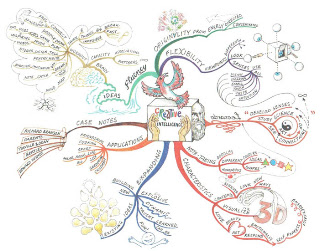
So, what's a mind map? Click here to read a basic overview that also lists some of the many uses, then check out my favorite template to share with clients below.

For non-linear thinkers and planners, especially those with ADHD or any ADD-like thinking, mind maps are excellent ways to capture ideas as they occur and (most importantly) act on them. You can write a speech, article or other presentation using a mind map, too. From the linked article above, here's a beautiful and creatively hand-drawn version:


© KiKi Productions, Inc. 2012

Aug 13, 2012

2012 Olympics Vocabulary Words

Summary: Say goodbye to the Olympics and hello to a whole new list of Olympics-related words and phrases.

 The 2012 Summer Olympics in London have officially drawn to a close. But it's not too late to use your Olympics vocabulary—and expand your daily vocabulary with new, globally current words.

EnglishClub.com has a whole host of quizzes and other links on Olympics-related vocabulary, including sports idioms like the pan-athletic phrases "at this stage in the game" and "blow the competition away." Interestingly, most sports-related phrases are used repeatedly in business speak. How many do you recognize and hear (or use) on a regular basis?

One term from that very list that I learned the origin of is "hot shot" (also "big shot"). It makes sense that this hunting term has come to mean someone who either is important or thinks he or she is important. However, EtymOnline.com states that in the 1600s, the phrase (still likely derived from hunting) meant someone who was reckless. The ingenuity in hunting technology is likely to credit for at least some of the changes in the word's meaning: Someone who shot too quickly in the past was reckless, while someone who shoots quickly today—especially using ready-loaded guns with sites—is likely on-target ... which just so happens to be another hunting idiom that's commonly used in the business world. (For example: "Your presentation this morning was really on-target with the board's concerns.")

© KiKi Productions, Inc. 2012

Aug 1, 2012

WOW Word of the Week: Laymanize

Summary: Forgot the buzzwords. Use real, reader-submitted words and laymanize it!

 Are you feeling overwhelmed by all the recent tweets and blog posts about industry speak and buzzwords? Laymanize it!

Just for fun, today I visited the open dictionary at Merriam-Webster.com—the section on the website where visitors like you and me can add our own words (and, yes, I have accepted the invitation to add my own words in the past). Have you added the words you use everyday? If not, visit the list for yourself and see what's missing that you can contribute: New Words & Slang Open Dictionary.

One word that jumped out at me from the "recently added" list was laymanize, defined by the adder as "to simplify a statement; to state in layman's terms." A sample sentence might be, "Doctor, instead of using medical jargon to answer my health questions, could you laymanize your answers?" ... Your doctor may or may not appreciate this request.

The etymology of this word? Well, that we'll have to come up with together in the true spirit of open dictionaries. First known usage on record would be 2012; and I'd wager the word stems from the English noun layman, meaning non-expert. Layman derives from the adjective lay (originating from the German Gothic lagjan, to put or to place) and the noun man (an ancient word stemming from multiple language roots, most recently meaning human being or person). To put something into layman's terms is to re-word it in language that's understandable to all. In other words, laymanize it!

© KiKi Productions, Inc. 2012

Jul 17, 2012

Summary: Welcome back to the Beyond Talk blog! Read today's post to learn more about last week's mini-blog tweet of the word granular as an industry buzzword.


Do you follow me on Twitter (@KealahParkinson)? If so, you've been getting mini-blog posts on WOW Words of the Week—industry buzzword terms like last week's granular.

Granular (GRAN - yeh - LEHR) – Its basic definition is something grainy or seemingly consisting of grains, such as sugar or sand; but in business-speak, it means finely detailed. In other words, it's getting down to the nitty-gritty. Sample sentence: "The client was pleased that Sue's proposal was granularly focused on the service schedule of our project." Etymology: This word entered the English language in the late 1700s from the Latin granule, a diminutive of the Latin word granum for grain or seed. Related word: Granola—which, when used colloquially to mean nature-oriented and/or modern-day-hippie, is decidedly un-business-oriented!

© KiKi Productions, Inc. 2012

Apr 27, 2012

Boost Soft Skills for Your Whole Team Now

If you read the last blog post on the POW Phrase of the Week "soft skills" and if you were intrigued by improving your own soft skill set, take heart—and take advantage: KiKi Productions, Inc. Communications Coaching is offering a spring sale now through May 30th on all workshops.

Here's what you get:

- In-depth teaching of The 3 Keys to Communication & how they can help each team member grow individually to benefit the group
- Custom content to meet your group's particular goals
- Interactivity to enhance the learning process
- Strategic insight on meeting future goals
- A printed copy of the e-workbook Speak Your Truth: How to Say What You Mean to Get What You Want for every member of your team.

Custom content includes any soft skills training your team needs. From conflict resolution to time management to goal-setting & accountability to more, you choose the right content for your team's needs. Not sure what content will work best for your team? No need to worry. Each workshop also comes with a free consultation to assess your team's challenges, as well as how your team members best learn.

Right now through May 30th, all this can be yours at a 20% discount. Contact me, kealah@kikiproductionsinc.com or phone 708-955-5131.


© KiKi Productions, Inc. 2012

Apr 3, 2012

WOW Word of the Week: SOFT SKILLS

Summary: Do you have the soft skills it takes to compete—and win—in today's business world? Find out what soft skills are and how to get them today.

This week's WOW is really a POW—a Phrase of the Week: soft skills.

 According to its Wikipedia definition, soft skills refers to a specific set of abilities that are often innate, but can be learned.

Let me repeat that: these skills can be learned. They just may take more time to learn than your traditional hard job skills.

What's the difference between "hard skills" and "soft skills"? Great question! So glad you asked.

Hard skills are things like typing, data input, computer programming, computer program usage, even memorizing sales scripts. They're the day-to-day duties you list in your résumé that help you land the job—or the ones you learned and practiced while on the job. Soft skills, by contrast, are things like crafting an appropriate email message that resonates with your client; training others to use company-wide computer and data systems; and incorporating the bottom line points of a sales script into your own, authentic language. They are the little extra flourishes you put in your résumé's objective or cover letter to ensure you land the job (and get along with your co-workers and employers)—things like "people person," "great listener" and "works well on a team." Here's more:

1. "Soft skills are personal attributes that enhance an individual's interactions, job performance and career prospects" and are "broadly applicable both in and outside the work place." (Wikipedia)

2. "Screening or training for" these types of skills "can yield significant return on investment for an organization." Studies have proven this to be true. (Wikipedia et. al.)

3. It's been suggested they're more important long-term than hard skills, or the occupational skill sets that can be more readily taught and learned—and even remembered by rote. (Wikipedia, KiKi Productions Inc. Communications Coaching et. al.)

4. Whereas "hard skills" are typically related to one's IQ, soft skills relate to your EQ, or your emotional intelligence quotient. (Wiki, KiKi)

5. Some of the top soft skills that employers look for can be found in this article.  (AOL Jobs)

Here are a list of soft skills that I teach my clients daily:

communication skills
conflict resolution
creative problem solving
strategic thinking/enhanced focus
icebreakers/cold calling
sales closing
rapport building
team building/team goal setting
personal goal setting & achievement
time management/effective appointment setting

Join me in the campaign to add this fabulous phrase, soft skills, to the dictionary—or at least the open/slang dictionary at Merriam-Webster.com. Click the link, submit the phrase and credit the article or blog entry of your choice!

And to add some much-needed soft skills to your own repertoire and résumé—or to improve your soft skill set—consider working with a coach like me or other communications coaches. Google the search term or check out my website to begin your journey to personal and professional improvement.

© KiKi Productions, Inc. 2012

Feb 13, 2012

WOW Word of the Week: Aphasia

Summary: Here's another brain-related A-word ...

Over the weekend, while curled in front of the fireplace and the television with my husband and our two cats, I was introduced to the story of Steve Goff. Formerly a successful Canadian business man, Goff suffered a stroke that left him with aphasia, or an inability to comprehend and speak words.

Aphasia can be caused by any number of brain injuries, as well as by birth defects and neurological diseases and disorders. Its effects vary from person to person—in Goff's case, he can speak a handful of expressive words and short phrases. During the televised interview I watched, he wrote singular, longer words on paper, and his daughter then translated his message into sentence form with Goff encouraging her along, saying, "Yes, yes," and "I know, I know, right!" His grasp of understanding the English language has not changed, however, his ability to formulate words has changed quite drastically.

In severe cases of aphasia, communication can be almost nil. But some communication is possible, and at least moderately successful proven therapies have included copying written words over and over to improve 'vocabulary,' and drawing for the same intention. When the distinctive visual aphasia is present, however, people with this brain challenge do not recognize written words either.

Other subsets of the disorder include receptive aphasia (normal speech with a hampered or non-existent ability to recognize written words), nominal aphasia (difficulty naming certain word groups, such as all verbs), and global aphasia which is the most severe form. However, even people in this subset are able to communicate with facial expressions and gestures. With creativity, regular communication is possible regardless of the severity.

Aphasia (eh - FAZH - ee - YAH)  or  (eh - FAZH - YAH) – (n.) loss of or impairment to word recognition and use, especially from some form of brain damage. Used medically in English as early as 1867, this Latin word derives from the Greek: a (without) and phasis (utterance).

© KiKi Productions, Inc. 2010

Feb 6, 2012

WOW WORD OF THE WEEK: Aboulia

Summary: Pardon my aboulia of late. It's taken me awhile to decide which direction to go toward with my 'next' blog post. Read on to see what broke the spell—and just what the heck aboulia is, anyway.

 On a recent trip to Terry Abner Salon to get my nails done by Jamie Fritze, nail tech extraordinaire, I spotted a book that jumped out at me amid the usual selection of home decor and celebrity gossip magazines. Although its title escapes me today (something along the line of Weird, Wonderful Words), the 1980s font is emblazoned in my mind's eye, along with the physical feeling of joy that overcame my being when I realized I could sit down in the lobby and escape into my favorite subject of all. ... And, well, that's weird and wonderful words.

I didn't get very far into the book before Jamie came to greet me with her usual stylish and sweet look and demeanor, accompanied by the lilting-voiced, "Hi, Kealah." (If you haven't read it yet, that's KEY - la. Think cartoonized singing house key.) But no matter: I only had to read the first entry to find a word I could newly love.

Aboulia (ay - BOO - lee - YAH) – (n.) the absence of willpower or decisiveness; an abnormal lack of ability to act or to make decisions that's characteristic of certain neurotic or psychotic conditions. Typically used as a medical term, the word can be spelled without the O, as in abulia. It hails from the same ancient Greek word that literally means "without will." With an adjective form, aboulic, it's been used in English presumably since the language's dawn.

What are some cognitive challenges that have aboulia as a symptom? They can include depression, mood disorders (bipolar disorder or schizophrenia), addiction/alcoholism, autism, and even ADD, especially when it comes to decision-making.

© KiKi Productions, Inc. 2012

Dec 5, 2011

What's Aspie for "Love"?

Summary: Waiting for the WOW Word of the Week? Try "Aspie," a derivative of Asperger for Hans Asperger, who first discovered the mild form of autism known now as Asperger Syndrome. And read on for the book of the week ...

 Do you speak Aspie? Have you even heard of this interesting 'language' of sorts? Often made up of sound effects and repeated phrases, it can frequently lack emotional terminology and understanding, in no matter what primary language one speaks it.

Aspie is a self-applied term by some members of the autism community who have Asperger Syndrome or High-Functioning Autism or other forms of otherwise "high-functioning" (read: more socially adaptable) autistic disorders. For decades, experts in the U.S. believed that anyone on the wide-ranging autism spectrum—including those on the more socially functional end—do not marry or partner in long-term relationships. And while relationships do hold a unique set of challenges for people with ASDs, or autistic spectrum disorders, they are not impossible.

So, here's another question: What interest does a Communications Coach have in Asperger Syndrome?

Well, this coach has a vested interest—especially now that I've co-authored a book on the subject. The Partner's Guide to Asperger Syndrome contains information gained in interviews with over 100 women married to men on the spectrum, plus some of their spouses, as well. As one woman has said, "If men are from Mars and women are from Venus, these couples feel like they come from different galaxies!"

Here's one story directly from the book:

Processing of emotional communication
  As we have seen, the ASD person likely finds it difficult or impossible to process large streams of verbal information that is shared by the NS person during a typical conversation or even a brief verbal exchange. This becomes even more complicated if the message is on an emotional level. This may be processed by her ASD husband as merely sounds with little meaning.
  This becomes even more complicated if the message is an emotional one. Even if he is able to hear all the words being spoken, the ASD person may not know what the NS speaker sees as important, so that he can understand the intended message.
  Many spouses have shared with us that positive emotions can become overwhelming for their ASD husbands, too.
  NS Kaye, for example, says that her husband Pete, who is on the autism spectrum, sometimes shouts at her in anger when she excitedly points out a rainbow in the sky. Kaye explains: "He can't tell the difference between when I shout for joy versus when I shout from anger."

Each chapter—including chapter 2 on Communication Differences, as quoted above—ends with a list of "Lessons Learned." In this case, these include directives to "Be concise in your communications and point out what you think is the most important part of what you are saying. Leave out unnecessary information" and to "Ask (if you are uncertain) how your spouse has interpreted a communication" among other suggestions. These lessons came directly from the couples interviewed who shared what's worked for them.

The Partner's Guide to Asperger Syndrome is available at Jessica Kingsley Press or Amazon.com.


© KiKi Productions, Inc. 2011

Nov 10, 2011

Answer to Monday's Question

Summary: Still waiting to find out why it may be a mistake to take a deep breath before going onstage? Here's your answer below ...

 If you listened to me on the air (or on your computer) Tuesday on WVLP-LP FM Valparaiso, you may still be wondering the answer to Monday's blog question: What's wrong with taking a deep breath to dispel your stage fright jitters?

The answer, which I promised to share in our show on "Overcoming Fears," but ran out of time beforehand, is simply this:

Taking a deep breath, if done quickly, can actually raise your heart rate and increase your body's parasympathetic nervous system response. In other words, you can heighten your emotional nervousness just by elevating your heart rate with excess oxygen. ... So, how do you slow down and relax?

It turns out deep breathing is the right thing to do, after all. But there's an important and distinctive catch: When you breathe in deeply, be sure to do so slowly. And even more importantly, be very sure to breathe out even more slowly than your inhale. Slowing your breath rate will slow down your heart rate, which will automatically send signals of relaxation to your body in turn. If you truly want to dispel agita, as in Monday's blog post example sentence, you'll follow these very important steps to breathing deeply and properly.


© KiKi Productions, Inc. 2011

Nov 7, 2011

WOW WORD OF THE WEEK: Agita

Summary: If you've ever experienced agita, or serious jitters, over a conversation or presentation, you can tune in to my radio program tomorrow to learn tips for calming your nerves. In the meantime, read the post below to discover the short history of the word agita.

Nod your head if this has ever happened to you: You're about to have a momentous conversation—something that impacts your career or your livelihood in a very important way—and you've rehearsed exactly what you want to say ... but every time you think about the impending moment, your knees get weak, your stomach turns somersaults and your throat closes up like a boa constrictor has your neck. Sound familiar?

That's agita, also known as agitation to most of us, and it isn't pretty. Want to know how to cure it? Tune in tomorrow morning to WVLP-LP FM 98.3 (or listen online anytime, including to the live broadcast) and hear some simple exercises you can do to dispel your nervousness and gain confidence.

Tomorrow's broadcast kicks off a brand new program called "Transformational Radio." Hosted by Randi Light, the show will share ways to better yourself in such important areas of personal growth as finances, health and wellness, personal and professional organization, and of course, communication. In this first episode, healing coach and hypnotherapist Randi and her guests (financial adviser Carey Yukich and communications coach Kealah Parkinson—hey, that's me!) will discuss "Overcoming Fears." I'll share what I know about overcoming your fears of public speaking or speaking with confidence in intimidating conversations, such as with a boss, potential clients, troublesome co-workers or even personal loved ones who just don't seem to know how to listen.

Comment here to have your questions answered on-air—or visit our Facebook events page and leave us a message anytime about this or future episodes.

Think you understand agita? Here's a little more info for the road:

AGITA (A - jih - TUH) – (n.) A feeling of extreme nervousness, agitation or anxiety. It sounds like an old, archaic word, but its first known use in the English language was actually 1982, making it a bit of a baby. As such a new word, not all dictionaries contain it. However, it does have old origins: It comes from the Italian acido, which is literally translated as heartburn or acid. Agita's grandparent is the Latin word for the same, acidus.

Merriam-Webster.com gives a fitting sample usage of the word: "She took a deep breath to dispel her agita as she stepped onstage." Tune in tomorrow to find out what's wrong with that tactic.


© KiKi Productions, Inc. 2011

Oct 31, 2011

Spooky Words for Halloween


 Boo! There's the word that tops today's list. And below (which is another creepy word, when you think about it from a Halloween-y context), is a spooky word list containing some of my favorites from this time of year. Taken from some other great Halloween word lists—also linked down below—this group of words is sure to make your skin crawl, a concept otherwise known as horripilation. Add that to your own list!

The words:

mausoleum
cemetery
cobwebs
Frankenstein
haint
wraith
hauntingly
horrific
creepy-crawlies
venomous
poison
cadaver
scourge


More lists at these links:

Your Dictionary's Spooky Halloween Words

Dark Scary Things from Visual Thesaurus


© KiKi Productions, Inc. 2011

Oct 10, 2011

WOW! WORD OF THE WEEK: Carillon

Summary: How is carillon related to clarion? Do these words make beautiful music together? I guess that depends on who's listening ...

Last night, lying in bed and reading, I came across a word that I pretty well figured out by context, but still wanted to look up, because it was new to me. Not only that, it's a word I would categorize as "pretty." After learning the exact meaning, "pretty" really does it justice, I think.

Carillon (KAYR - eh - LON) - (n.) a set of fixed, chromatically tuned bells sounded by hammers that are controlled from a keyboard; also an electronic instrument that imitates the carillon or a musical composition created for the carillon. The etymology of the word carillon is straightforward, but rich—perhaps a little like the instrument, itself. 


Entering English in 1775 from the French (same word, different pronunciation [don't forget to click the link by the word above to hear how it sounds in English today]), it derives from the Old French carignon, meaning "set of four bells." This traces to the Latin for "set of four," quaternionem, which derives from quarter, also Latin and meaning "four times." Carillon's base origin traces back five and a half thousand years—well before such an instrument was ever even in idea form, likely—to the Proto-Indo-European word for four, kwetwer. (Now, that's one I'd categorize as a "funny" word! Say it as fast as you can, and it sounds like a sneeze.)


Researching this all for today's blog post, I wondered if this WOW! Word were any relation to clarion.  The answer is yes—and no: While the two don't share any similar root words, they do follow the same path to the English language, from Latin to Old French to French, then English. Look up the definition, and you'll find even more they share in common. Then check out the history of the carillon, too.


As a sidebar, the book I was reading used this lovely word in a beautiful metaphor. The exact quote is: "While that first gloss had not set off any bells for Alan, Evan-Wentz's translation set off a carillon." [From Destructive Emotions: How Can We Overcome Them? (A Scientific Dialogue with the Dalai Lama, narrated by Daniel Goldeman, author of Emotional Intelligence)] ... Don't you just think that sentence has a nice ring to it?


© KiKi Productions, Inc. 2011

Sep 27, 2011

WORD OF THE WEEK: Tatterdemalion

Summary: Fun, games, Broadway musicals and word learning—it's all inside today's post on the word tatterdemalion.

 In an effort to get back in the swing of things and jump-start my return to weekly word blogging, I took a little timeout today to play some online word games. (Stay tuned for a future post on some of the fun ones.) It worked! Not only did I enjoy myself, I learned a new word—the whole goal all along, of course: tatterdemalion.

For anyone who's ever seen Les Miserables, or even ever seen a poster for the musical, a tatterdemalion is not something new to you ... at least not in imagery.

You may better know a tatterdemalion by its other more common name:

Tatterdemalion (TAT - ter - deh - MAYL - yuhn) – (n.) raggamuffin; a person dressed in shambles or loose, bedraggled clothing.

It's likely related to its obvious cousin tatter—though at least one source questions whether its true ancestor may be Tartar, as in gypsy or vagabond. Wherever it came from, it entered English in the very early 15th century.

So, in closing: Happy 25th anniversary, Les Mis!


© KiKi Productions, Inc. 2011

Sep 19, 2011

Blog Hiatus & Contest Winner: Welcome to Your New Normal

Summary: If you found another blog to help you build your vocabulary while the writer of this one was M.I.A., I don't blame you. Share your fave finds—and read my whiner explanation for absence below. (It may surprise you.)

After a month and a half without WOW Word of the Week vocabulary building—and without posts about communication skills or cognitive/thinking skills challenges; without even personal updates—I'm back! And so are all of these posts and more.

Why the radio (or internet) silence? Life got crazy at the end of the summer as my client list grew at just the exact same moment that my husband and I (and our two cats) moved from a mold-ridden home into the brand new home we'd spent the better part of a year building ... with the amazing assistance of an organization called L.A.R.R.I. that's a division of the United Way. This "organization" is made up of very generous and giving people, and funded by some just-as-generous grants. Words cannot express the gratitude that I feel for this very amazing gift.

As I enter into this new era of life—in a new home (with a new home office, too!), a new list of clients, and a new book due out this fall—I'm glad to be restoring a sense of normalcy to my day-to-day routine. The fact that this "normalcy" is so upbeat and inspirational is another gift altogether.

And speaking of gifts, or prizes at any rate: I'm pleased to announce (though saddened to announce so belatedly) that the winner of July's blog contest winner is Melissa Osika. Melissa earned bonus points for using truculent in a sentence. For that, she gets pure bragging rights. She also happens to be the winner of a free copy of the electronic workbook that aims to improve communication skills, Speak Your Truth: How to Say What You Mean to Get What You Want. Here's wishing Melissa a new time of new growth in her own life as she completes the workbook exercises and discovers her personal truth. Melissa, welcome to your new normal!


© KiKi Productions, Inc. 2011

Jul 21, 2011

WOW Teaser: Truculent

Summary: Today it's your turn to look up a word and see what you can find. Share your findings in a comment post—and you could win a prize!

Recently, I read a newspaper article that I'm sure was written by an A.P. reporter. What makes me say that? Why the use of only one word: truculent.

Want to know what it means? Well, for today anyway, you're on your own. Use the remainder of this week to do a little searching (here's a nice list of e-dictionaries to help you with your search), and post your findings in the comments section of this blog post. The first person to correctly respond in each category—definition, etymology and pronunciation (we love sound files here!)—will win a nice prize: a free e-workbook titled "Speak Your Truth: How to Say What You Mean to Get What You Want."

Ready, set, search!

© KiKi Productions, Inc. 2010

Jul 12, 2011

WORD OF THE WEEK: Salubrious

Summary: Do you like word games and building your vocabulary? Read today's post to do a little of both. It's good for your (mental) health ...

In a fit of momentary boredom while trying to decide on this week's WOW (Word of the Week), I played a word game on Merriam-Webster.com. Okay, it's not so much a game as it is a quiz—but to word nerds like me, word quizzes are lots of fun! ... Just more so when you're 'winning.' And, yes, by winning I mean getting all the answers right.

I was not doing so well, myself. The 10-second timer at M-W.com really threw me off. I'm much better on FreeRice.com, where timing isn't everything, but knowing the right word meaning is. (And correct answers help feed the hungry, too.) Despite my struggling to click on the correct definitions to words I already knew (seriously), I was somewhat strangely relieved when I received the visible buzzer banner for a word I didn't know: salubrious.

Salubrious (Suh - LOO - BREE - uss) – (adj.) healthful; promoting health and well-being. First used in the mid-16th century, this word comes from the Latin salubris, which shares the same definition. It's also related to another Latin word, salvus, meaning safe. Its opposite is, not surprisingly, insalubrious. For example: Smoking is a rather insalubrious way to deal with stress.

So, now we both know another new word. Don't forget to click on the pronunciation link above to hear just how to say it.

© KiKi Productions, Inc. 2011

Jul 6, 2011

WORD OF THE WEEK: Pyrophile

Summary: Taken directly from the number 1 spot of Merriam-Webster.com's Top 10 List of Particular Kinds of Lovers, pyrophile in today's post shares a little etymology and a little of my own—and our country's—celebratory history.

Pyrophile (PIE - roe - FILE) - (n.) in essence, a pyromaniac. The exceptions are that a pyrofile may: (a) be drawn to volcanoes and/or staunchly hold tight to the notion that volcanic energy comes from a connection to the earth's core, or (b) love fireworks as much or more than fire, itself.

In this last sense of the definition, my husband is definitely a pyrophile! And it's fitting that the word should be this week's WOW: Not only is it the week of our nation's celebration of independence—with fireworks galore—but it's also the day after my 8th wedding anniversary. And, yes, as would be expected of anyone marrying on the 5th of July, our wedding was certainly celebrated with fireworks. In fact, I was impressed back then with my then-new partner's ingenuity: With the supervision of two of our firefighting friends (pyrophiles in their own rights), he custom-built a fireworks launcher to set up the evening's show. For five years after the event, we held an annual 4th of July-slash-anniversary party, inviting back many of our wedding guests, and hosting yet another fireworks show. It was always so fun!

This year, we had a smaller, more private event. Although there was no automation and sound to enhance our fireworks display, I got in on the old-fashioned, fuses-and-lighters-style fun. That's right: I lit my first large firework (and then several more), as my mate passed his pyrophile bug right on to me. Now I totally get what all the buzz is about.

So, happy Independence Day! Enjoy the rest of your week and your life of freedom. (And happy anniversary to my baby!)

© KiKi Productions, Inc. 2011